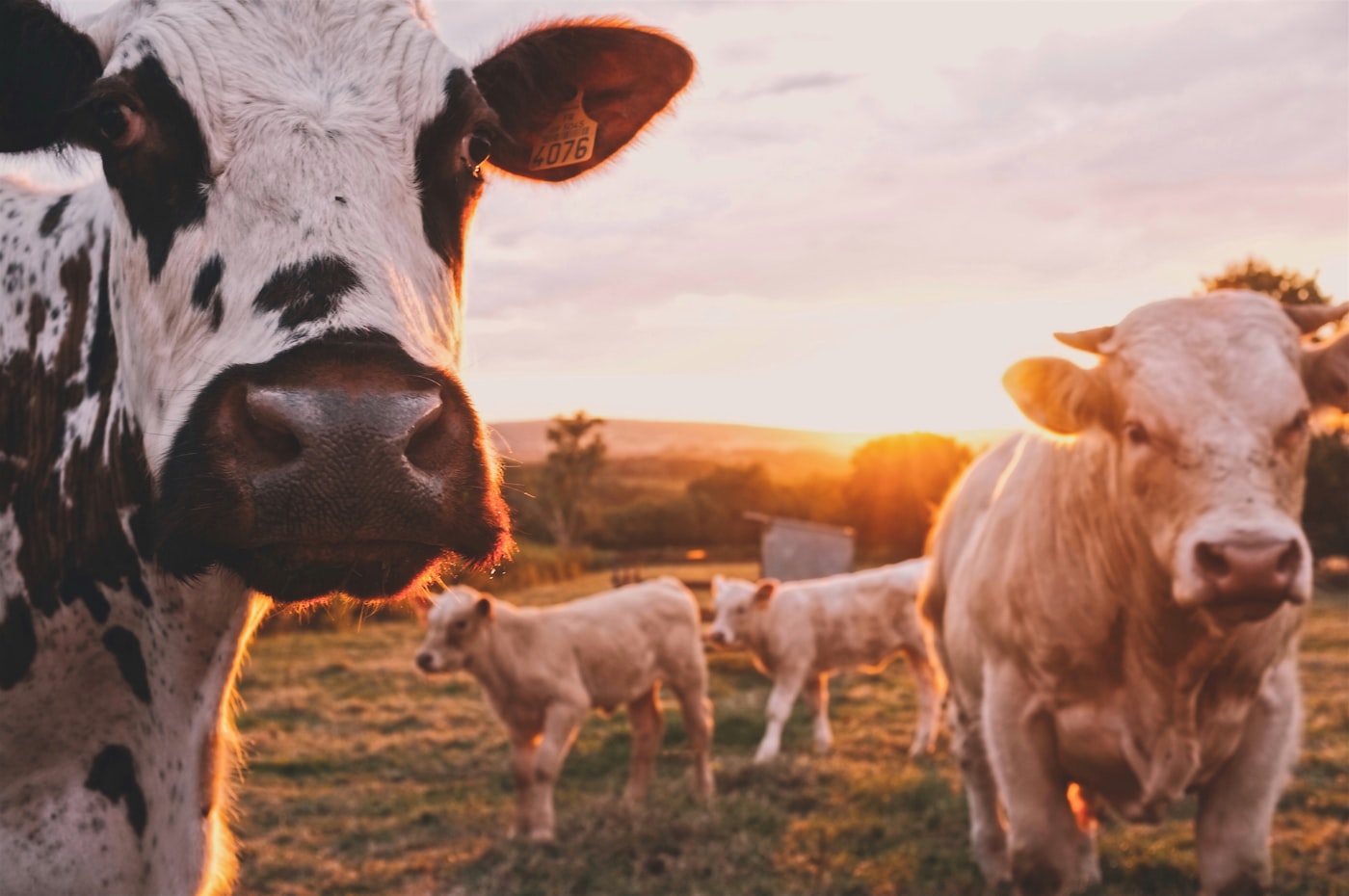
Most people who seek out grass-fed and pasture-raised meat do so for health reasons — but what they're also choosing, without always realizing it, is a fundamentally different life for the animals. On a well-managed pasture, animals can do what animals are built to do: graze, explore, rest on soft ground, and socialize. The research backs this up.
The Foundation
The Five Freedoms — and how pasture delivers them
Veterinary and animal welfare scientists around the world measure farm animal welfare against a framework called the Five Freedoms, developed by the UK's Farm Animal Welfare Council. Pasture-based farming is uniquely positioned to fulfill all five in a natural, uncontrolled environment — not just on paper, but in practice.
Freedom from hunger & thirst
Pasture provides continuous access to fresh forage — cattle's natural diet — alongside clean water sources, so animals graze at their own pace throughout the day.
Freedom from discomfort
Soft pasture grass provides a natural resting surface. Studies show pasture-raised cattle have significantly better hoof health and lie down more comfortably than confined animals.
Freedom from pain, injury & disease
Lower animal density on pasture reduces disease transmission. Outdoor-raised pigs, cattle, and poultry consistently show fewer respiratory and intestinal problems than their confined counterparts.
Freedom to express normal behavior
This is where pasture truly shines. Grazing is a core behavioral need for cattle — the inability to graze causes frustration and behavioral distress. Open pasture also allows full social interaction and choice of companions.
Freedom from fear & distress
Research using the Welfare Quality® protocol finds pasture-raised cattle score dramatically better on human-animal interaction tests — with smaller flight zones, lower reactivity, and calmer responses to handlers.
What the Science Shows
Animals do what animals are built to do
Peer-reviewed studies published in journals including Frontiers in Veterinary Science, Animal, and Scientific Reports consistently find that pasture access allows livestock to express their full behavioral repertoire — something confinement systems fundamentally cannot provide.
Cattle on mountain pasture in one University study were active for more than 12 hours per day, moving freely and grazing as their biology demands. The researchers concluded: "Pasture-based husbandry systems enable cattle to express their natural behaviors such as grazing, freedom of movement, and social interaction, and thus provide better welfare than confinement systems."
"Studies in grazing cattle, sheep, and goats generally report better animal welfare indicators, especially when ruminants can select a diverse mix of grasses, forages, and shrubs, allowing them to express their innate behaviors."
Arelovich et al., PMC — Frontiers in Animal Science, 2025This isn't just about comfort — it's about biology. Ruminants evolved to graze for many hours daily. Restricting that behavior doesn't just limit movement; it creates chronic frustration and stress that researchers can measure physiologically.
Measurable Outcomes
Lower stress, fewer injuries, healthier animals
Animal welfare isn't abstract — it's measurable through cortisol levels, injury rates, disease frequency, and behavioral indicators. Across species, the evidence for pasture-raised animals is consistent.
Across the Farm
Welfare benefits across species
Grass-fed and pasture-raised practices apply to more than cattle. Across species, access to open pasture produces measurable welfare improvements aligned with each animal's natural biology.
Beef Cattle on Pasture
- Graze naturally for 8–12+ hours per day, fulfilling core behavioral needs
- More active daily movement supports cardiovascular and musculoskeletal health
- Herd social structure maintained — animals choose companions freely
- Lower flight zone and stress reactivity compared to feedlot cattle
- Dramatically lower incidence of respiratory disease at lower stocking densities
- Natural forage diet reduces rumen acidosis risk associated with high-grain feeding
Dairy Cows with Pasture Access
- Improved general health and greater longevity of breeding animals
- Ability to freely choose where to eat, drink, and socially interact
- Soft pasture surface reduces lameness and joint stress compared to concrete barn floors
- Lower levels of environmental pathogens than in high-density barn systems
- Natural light exposure and seasonal variation support reproductive cycles
- Pasture-based dairy cows show fewer stereotypic behaviors linked to frustration
Pasture-Raised Poultry
- Free-range chickens express natural foraging, dust-bathing, and ranging behaviors
- Access to sunlight and fresh air supports immune function
- Dramatically lower stocking density reduces injurious pecking and aggression
- Ability to establish and maintain natural flock social hierarchy
- Research shows pasture-raised laying hens exhibit far fewer stress-related behaviors than caged birds
- Natural diet supplemented by insects and greens supports nutritional needs
Pasture-Raised Pigs
- Pigs are intelligent, curious animals — pasture provides critical environmental enrichment
- Natural rooting, foraging, and exploration behaviors fully expressed outdoors
- 2026 Scientific Reports study: outdoor access significantly lowered cortisol and reduced body lesions
- Fewer respiratory diseases than indoor-raised pigs at equivalent growth rates
- Fewer intestinal diseases, associated with lower pathogen exposure outdoors
- Access to natural substrate (soil, grass) meets foraging behavioral needs
Grass-Fed Sheep & Lambs
- Sheep evolved as grazing animals — pasture is their natural and preferred habitat
- Diverse grass and forage selection supports rumen health and species-typical behavior
- Ewe-lamb bonding and social group structures maintained naturally on open pasture
- Better hoof condition with natural movement over varied terrain
- Research shows grazing sheep have better welfare indicators than housed sheep
- Wool-bearing breeds particularly benefit from natural thermoregulation outdoors
Our Standard
How eatWILD verifies welfare practices
Since 2001, eatWILD has maintained a rigorous set of listing criteria for every farm in our directory. We don't just ask farmers to check a box — our criteria are specific, species-appropriate, and tied to actual management practices that produce real welfare outcomes.
Every farm listed on eatWILD has attested to meeting criteria appropriate for the species they raise. We verify the details farmers provide, and farms that no longer meet our standards are removed from the directory.
"We are committed to helping consumers find food from animals that spent their lives on pasture — not as a marketing claim, but as a verifiable management commitment."
Jo Robinson, Founder, eatWILD.comWhen you find a farm through eatWILD, you can ask them directly about their practices. The farms in our directory welcome the conversation — they're proud of the way their animals live.
Key References
- Arelovich et al. (2025). "Interconnection between pastures, grazing ecosystem, animal welfare, meat quality, and human health." Frontiers in Animal Science / PMC.
- Romero et al. (2025). "Beef cattle welfare: the role of Integrated Systems in animal adaptation and productivity." Frontiers in Ethology.
- Scientific Reports (2026). "Regular outdoor access decreases stress with positive effects on the health of growing pigs raised on a conventional farm." HAL INRAE.
- Food Animal Concerns Trust (FACT). "Benefits of pasture-raised livestock and poultry." Cornucopia Institute Summary.
- Pilarczyk, B. (2024). "The Welfare of Cattle in Different Housing Systems." DOAJ.
- AgResearch New Zealand. "White Paper: Pasture-fed livestock production and products." agresearch.co.nz
- Farm Animal Welfare Council (FAWC). "Five Freedoms." UK Government.